
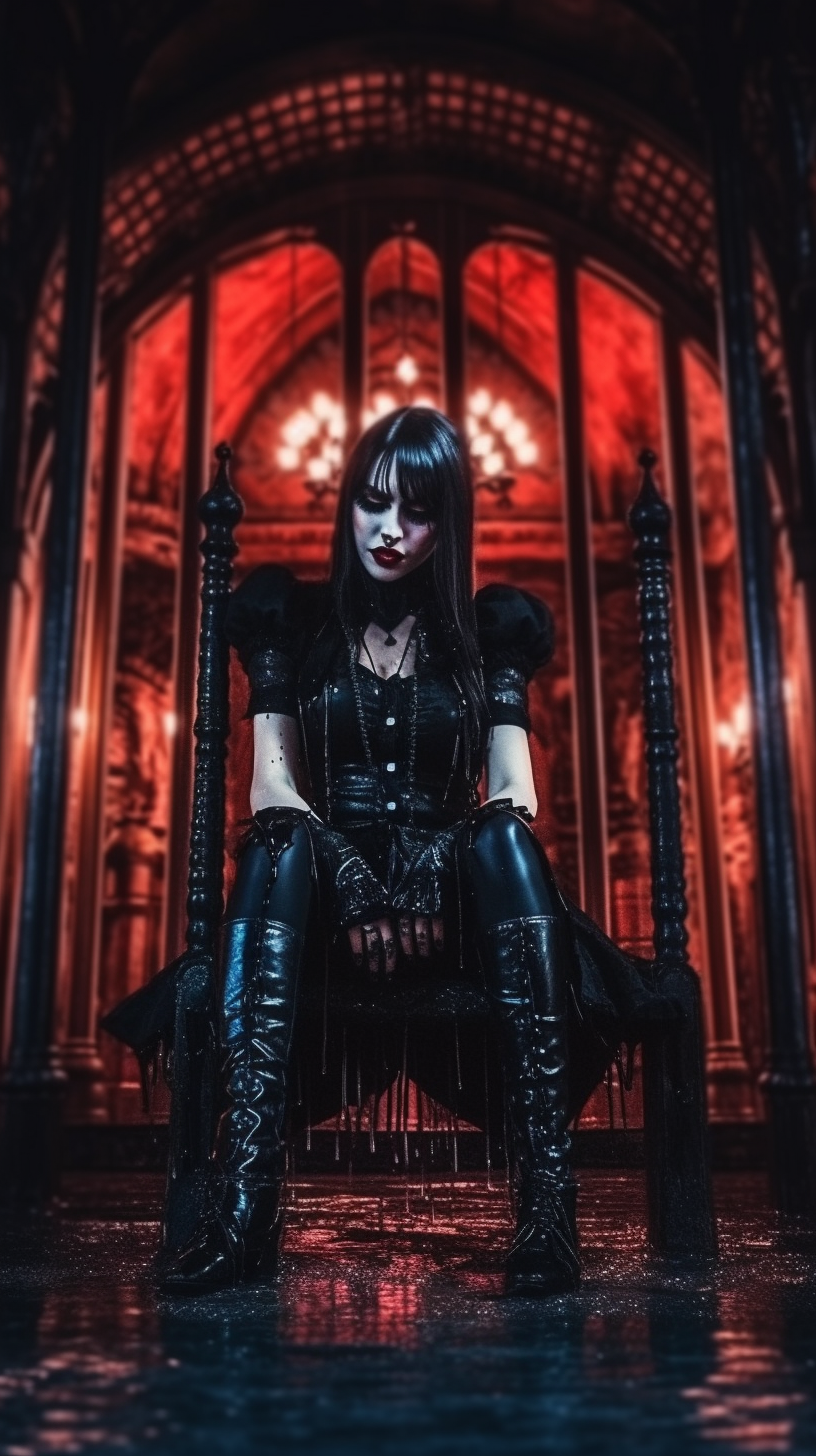
The Lady in the Red Hall
The villagers of Harrow’s End said the red windows of Blackmere Abbey bled at night.
I didn’t believe them. I’m a glazier. I have spent twenty years with lead and glass, and I know that red glass looks like blood when the light is right. That’s all it is. That’s what I told the carter who dropped me at the abbey gate in the rain, crossing himself twice before he whipped his horse around and fled down the hill.
My name is Thomas Wren. In the autumn of 1894, a solicitor in London hired me to restore the seven great windows in the abbey’s main hall. The pay was triple my usual rate. The letter said the owner would meet me on arrival.
I should have asked why a pay that high.
The hall was enormous. Black stone pillars rose into shadow, and tall arched windows of deep crimson glass lined the far wall, each lit from behind by a glow I couldn’t explain. There was no sun that evening, no moon, and no lamps outside. Yet the glass burned red, and the candelabra painted on the panes seemed to flicker like real flames.
Beneath those windows stood a great chair of black carved oak, with tall posts topped by sharp, polished finials. A woman sat in it.
She was young, or looked it. She wore a black dress with puffed sleeves and a tight bodice buttoned in silver, and a choker with a small dark pendant. Black lace gloves covered her hands, which rested in her lap. Her boots were tall and glossy, laced to the knee, and they shone like wet tar. Long dark hair fell around her pale face, with heavy bangs that hid her eyes. Her lips were painted a deep, dark red.
Her head was bowed. She didn’t look up.
“You’re late, Mr. Wren,” she said. Her voice was soft and very tired.
I took off my hat. “Forgive me, ma’am. The roads were poor. Are you the owner?”
“Of a sort.” She still hadn’t lifted her head. “The sixth window is cracked. Please leave it.”
“I’m sorry, I was hired to repair…”
“Please.”
Then I noticed the floor.
It was wet. The stone around the chair gleamed like a pond, black and red, reflecting the windows. Drops were falling from the hem of her dress and from the tassels of the chair, slowly, one at a time, like the ticking of a clock. I looked up. The ceiling above her was dry as bone.
Whatever was dripping, it wasn’t coming from the roof.
I told myself it was none of my business. I set up my scaffolding that night.
The sixth window held a saint. Most of the panes in that hall did: robed figures in dark red glass, each with a hammer or a staff or a book. But the saint in the sixth window was a young monk with a hammer in one hand and a lamp in the other, and the longer I looked at his face, the colder I felt.
He had a crooked nose, broken high on the bridge. He had a small scar in the left eyebrow. He had a way of tilting his head to one side, as if listening.
I had a crooked nose, broken high on the bridge. I had a scar in my left eyebrow. My wife used to say I tilted my head like a dog hearing his name.
“Coincidence,” I muttered.
Behind me, a drop fell on stone. Tick.
I worked three days. By the third night, I’d found out why the villagers feared the glass.
It was warm. Real red glass, even in summer, is cool to the touch. This was warm, like skin, and when I scratched a thin flake from a cracked edge and held it to my nose, it smelled of iron. Of old pennies. Of blood.
I sat down on the scaffolding and understood that I wasn’t repairing a window. I was repairing something that had been made from people.
“Do you know what the red is?” asked the lady.
She hadn’t moved. She hadn’t lifted her head in three days. But her voice carried across the hall clearly.
“Blood,” I said. My mouth was dry. “It’s blood, isn’t it?”
“The blood of seven monks,” she said. “They volunteered. They bled into the glass, one for each window, and gave their souls to it, so that the windows would watch over me.” A faint, bitter smile touched her red lips. “They were very devout. They thought they were sealing a demon.”
“Were they?”
“Ask the sixth window.”
I climbed back up the scaffold with trembling hands. I looked into the saint’s red eyes, and in the warm, wet glow, something moved behind them. Something looked back.
The crack in the glass was wider than it had been that morning. A thin thread of crimson light slid across the floor toward the chair.
“Mr. Wren,” said the lady, very gently. “Stop.”
“I’m not doing anything.”
“You are.” Now she sounded afraid. “Look at your hands.”
I looked. My fingers, resting on the lead came, were glowing the same soft red as the glass. The crack widened with a sound like ice breaking under a boot.
I jerked my hands away. The glow stayed. I felt it spreading up my wrists, warm and sweet and horribly familiar, as if my own blood were singing.
And in my head, like a door swinging open, a memory that wasn’t mine.
A stone hall. Torchlight. A man in a brown robe with a hammer in his hand, kneeling before a woman in a black chair. She was weeping. Her tears ran dark. He was saying something, over and over, something I couldn’t quite hear.
I’ll come back. I swear it. I’ll come back for you.
I fell from the scaffold. The floor rose to meet me, wet and cold. When I opened my eyes, the lady was standing over me.
I hadn’t heard her rise. Her boots made no sound. Up close, she was beautiful in a way that made my chest ache, a pale, sorrowful beauty, like a statue left out in the rain. Dark tears had run down her cheeks and dried at her chin. Her lips were parted, and I saw her teeth: small, white, and sharp.
She lifted her head, and for the first time, I saw her eyes.
They were black and endless and swimming in tears.
“Anselm,” she said.
“My name is Thomas.”
“I know.” She knelt beside me, and her gloved hand touched my cheek, light as a moth. “You are always Thomas, in this life. Three hundred years of Thomases, Wrens and Wrights and Wrays, each of them a glazier, each of them born with your crooked nose. Did you think it was luck, that you were hired?”
I couldn’t speak.
“The Order bound me in this chair,” she whispered. “They said I was a monster. You were their brother. You built the windows with them. You said it was for my protection, that the hunters were coming, that if I sat here, behind the red glass, they’d never find me.” Her voice cracked. “You promised you’d come back and open the doors when it was safe.”
“I don’t remember…”
“You died,” she said. “The fever took you the winter after. They never told me. I sat here for three centuries, waiting, bleeding into the stone, while the seven windows watched. And every time your family sent a glazier to mend the glass, I hoped it was you.”
A drop fell from the hem of her dress. Tick.
The tears. All those years, the dripping had been her tears.
“I’m sorry,” I breathed. And God help me, I meant it, though I didn’t know for what.
“I know.” She smiled, and it was the saddest thing I’ve ever seen. “That’s why I forgive you.”
Behind her, the sixth window shattered.
The glass burst outward in a storm of red shards that rang against the stone like bells. The light went out of the hall all at once. The other six windows dimmed, and I heard sounds from them, six soft, sighing voices, like men setting down a heavy burden at last.
The lady bent over me. Her cold lips brushed my throat.
“I forgive you,” she whispered again, and I felt her teeth.
That was nine weeks ago.
I’m writing this at a desk in a tall room with no windows, though I know it is deep in the abbey. A fire burns in the grate. A wine glass sits at my elbow, filled with something dark that I don’t ask about. My hands no longer glow. They shake, though, and they are very pale.
The villagers say Blackmere is empty now. They say the red windows stopped bleeding, and that the sixth one is clear, and shows only the empty sky.
They don’t know about the seventh.
She comes to me every night, after dark. She sits beside the fire in her black dress and her shining boots and her lace gloves, and she brushes my hair back from my face with infinite care. She says she forgives me. She says it every single night, with my blood still warm on her lips.
I believe she means it.
That’s the worst part.
The Rotting Dish: A Tale of Terror and Survival