
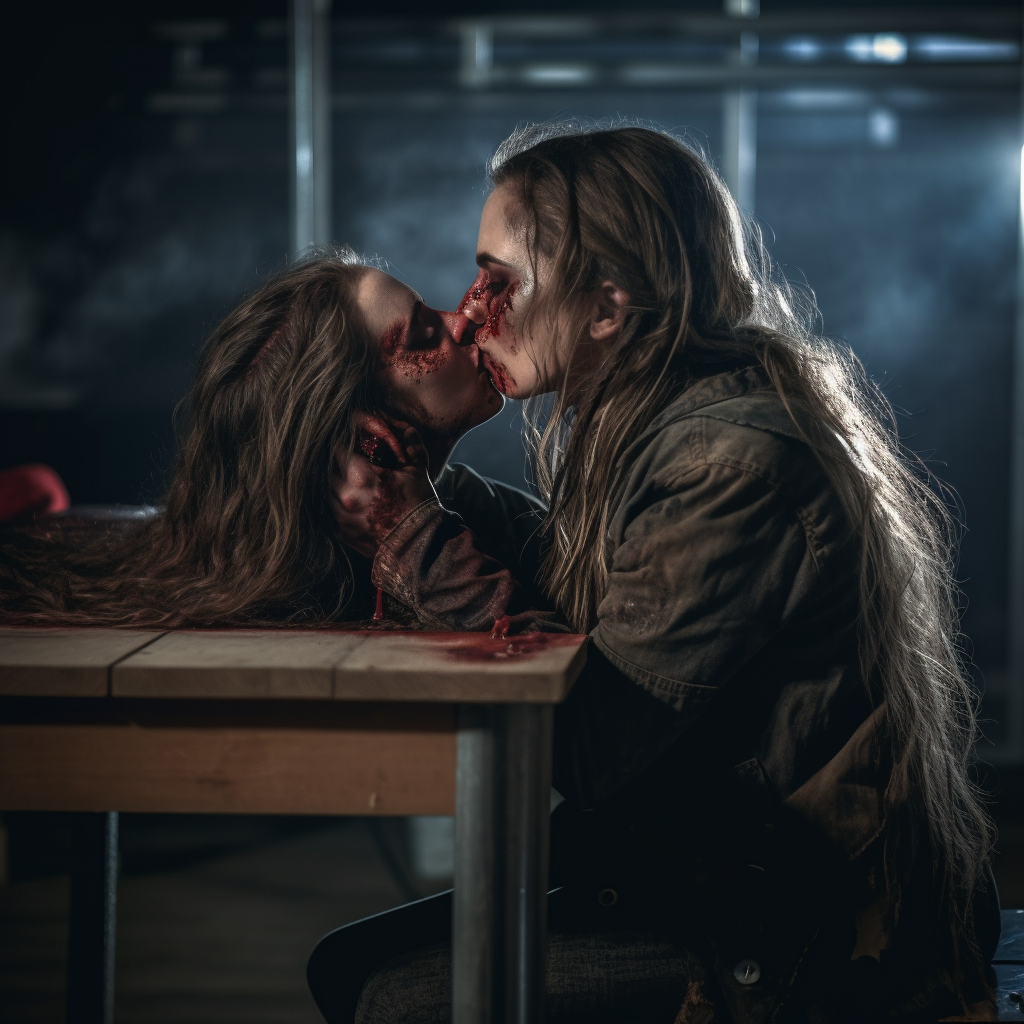
The Last Kiss at Station Six
They tell you not to touch the clients. They tell you a lot of things at Halcyon Memorial.
My name is Marnie Voss. For two years I worked the night shift at Halcyon, a private facility on the edge of town that sells families something no hospital will: a Final Hour. When a loved one dies in a way that leaves the body unrecoverable, our technicians preserve the head on a perfusion rig for seventy-two hours. The brain stays warm. The eyes open. The lips can still shape a few words. Families come in, sit by the table, and say goodbye.
It’s a business. It pays well, and I told myself it was a kindness.
Then they wheeled in Station Six.
I knew the name on the tag before I knew anything else. Whitaker, Cassandra, age 29. Route 9 collision. Vehicle fire. Cass was my girlfriend of four years. Nobody at Halcyon knew that. Her parents were out of the country, and the hospital had no one else to call, so they called the lab that carried her insurance rider.
I did the prep myself. I won’t describe it. I’ll only say that when the body is lost, there is a clean line where the neck ends, and I washed that line with the same hands that used to braid her hair.
Her eyes opened on the second night.
The facility was quiet. The fluorescent lights hummed overhead. The rig clicked and sighed beside Station Six, pushing warm blood through the tubes into the base of her throat. I had been sitting beside her for an hour, not speaking. Then her lashes fluttered, and her eyes found mine, brown and wet and entirely alive.
“You smell like the river,” she whispered.
I stopped breathing.
“Cass.”
“You always smelled like it after.” Her mouth curved, slow and sleepy. “Come closer, Mar. I can’t turn my head.”
I leaned down. I was crying, and I didn’t care who might see. Her lips were cracked and dark, and the left side of her face was stippled with a spray of dried blood where the glass had gone in. She looked up at me with so much love that it hurt to hold her gaze.
“Kiss me,” she said.
I should have remembered the rules. I kissed her.
Her lip split against mine. I tasted iron, hot and thick, and the world went white.
I was in the car.
I was behind the wheel on Route 9, the radio loud, the bottle between my knees. Cass was in the passenger seat, laughing, her hand on my arm. Slow down, Mar. Headlights swung across the windshield, and I felt my own foot press down harder. I heard my own voice say, Relax, I’ve got it.
I came back to the lab with a gasp. I was bent over the table, shaking, her blood still on my tongue.
“You were driving,” Cass said softly.
“No.”
“You told them I was driving.”
“I don’t remember…”
“You told the police I took the wheel. You told them you were thrown clear.” Her eyes never left mine. “It’s all right. I know why. You were scared. You’ve always been so easily scared.”
I was sobbing now, shaking my head, backing away from the table until my hip hit the wall. She was right. I knew she was right. For three weeks I had told myself a story where I hadn’t been the one behind the wheel, where I hadn’t smelled the whiskey on my own breath, where I hadn’t walked away from the wreck with a scratch on my cheek while the fire took everything else.
“I’m sorry,” I said. “Cass, I’m so sorry.”
“Kiss me again,” she said. “Kiss me again, and I’ll forgive you.”
I went back to her. Of course I did. I’d have done anything.
The second kiss was colder. I felt something tug at me, deep behind my breastbone, as if a hook had caught under my ribs and given a slow, patient pull. When I pulled away, my lips were numb, and Cass’s cheeks had color in them. Real color, pink and warm, where an hour ago there had been wax.
“Better,” she sighed.
I glanced at the rig.
The blood in the tubes had stopped moving. The pump was still clicking, but the lines were still, the red dark and congealing in the plastic. Whatever was keeping her alive now, it wasn’t Halcyon’s equipment.
At the base of her neck, where the clean line ended, something was moving.
Thin red threads. They came out of the flesh like roots out of damp soil, each as fine as hair, glistening. They crept across the steel of the table, slow and curious, feeling their way toward my hands.
“Cass,” I said carefully. “What’s happening?”
“You’re so warm,” she murmured. She sounded dreamy, like someone waking from a long sleep. “I forgot how warm you are.”
I tried to step back. My legs wouldn’t move. I looked down and saw a red thread wrapped around my left wrist, tight and neat as a bracelet. Another coiled around my right. They were thin as fishing line, and they were pulling.
I could feel it now. A steady, soft draining, like a bath slowly emptying. My fingers had gone pale. My head swam.
“Don’t be scared,” said Cass. “It doesn’t hurt. You know it doesn’t hurt.”
The alarm panel on the wall was ten feet away. Beside it was a red switch under a plastic cover, labeled TERMINATE. We used it when a rig failed and a family didn’t need to see what came next.
I dragged myself toward it. Every step cost me. The threads stretched, and where they pulled, thin lines of blood welled up and beaded down my forearms.
I got my hand on the cover. I flipped it up.
“Marnie,” said Cass.
I stopped. I couldn’t help it.
“You killed me once,” she said, with that terrible tenderness. “You can do it again. But this time, you’ll know exactly what you’re doing.”
I stood there with my hand on the switch, shaking, tears running down my face, and I understood that she was right about that too. The first time, I hadn’t known. The first time, I had only been a coward.
I didn’t flip it.
I let my hand fall.
I don’t know how long it took me to cross the room. The floor tilted. The lights blurred. When I reached the table, the threads had spread across the steel in a bright red web, and Cass’s face was glowing, flushed and young and so beautiful that for a moment I forgot to be afraid.
Below her chin, where there had been only a clean line of flesh, there was now a shoulder. A collarbone. The beginning of an arm, pale and wet and perfect, unfolding from the stump like a flower opening.
“Almost,” she whispered. “Just a little more, Mar.”
The threads climbed my arms. They reached my shoulders, my throat. I felt them slide under my jaw like fingers. I felt something inside me go quiet and loose.
I laid my head down on the table, beside hers.
I told myself I was resting. I told myself she would stop.
Her new hand came up, slick and warm, and cradled the side of my face.
“Thank you,” she said, and kissed me.
I’m writing this the only way I can, in my head, one slow word at a time. I can’t move my hands. I can’t move anything. My cheek is pressed against the cold steel of Station Six, and my eyes are open, and I can see the room sideways, the clock above the door, the long black windows.
The day shift arrives at seven. I know because I’ve heard them come in, every morning for two years. The door will open, the lights will flicker on, and they will find a young woman sitting at Station Six in a brown work jacket, with long hair and a smear of blood on her face. She will tell them she is Marnie Voss, that she hasn’t slept, that the rig failed overnight and she stayed to keep the client company.
They will believe her. Why wouldn’t they?
Cass is wearing my jacket now. It fits her better than it ever fit me. She sits very straight in my chair with her new hands folded on the table, humming the song we danced to at her cousin’s wedding. Every few minutes she leans down and kisses me, soft and slow, and I taste iron, and something deep behind my ribs lets go a little more.
“Four years,” she says against my mouth. “Four years you got. Let’s see how long you last.”
The door handle turns.
I try to scream. All I can do is blink.
She smiles at me, and she lifts her head to greet the morning.
The Fog That Follows: A Chilling Small-Town Horror Story