
The Last Note at The Blue Hollow
At 1:13 every morning, a single spotlight clicked on above the empty stage of The Blue Hollow, and a dead man began to play.
I was the only one who ever saw it. I closed the bar alone, six nights a week. By one o’clock the last drunk was in a cab, the chairs were upside down on the tables, and the building felt like it was holding its breath. Then the light clicked on. A stool creaked. And a guitar began to sing in the dark.
I’ll tell you what I saw, because nobody believes me, and I’m done caring.
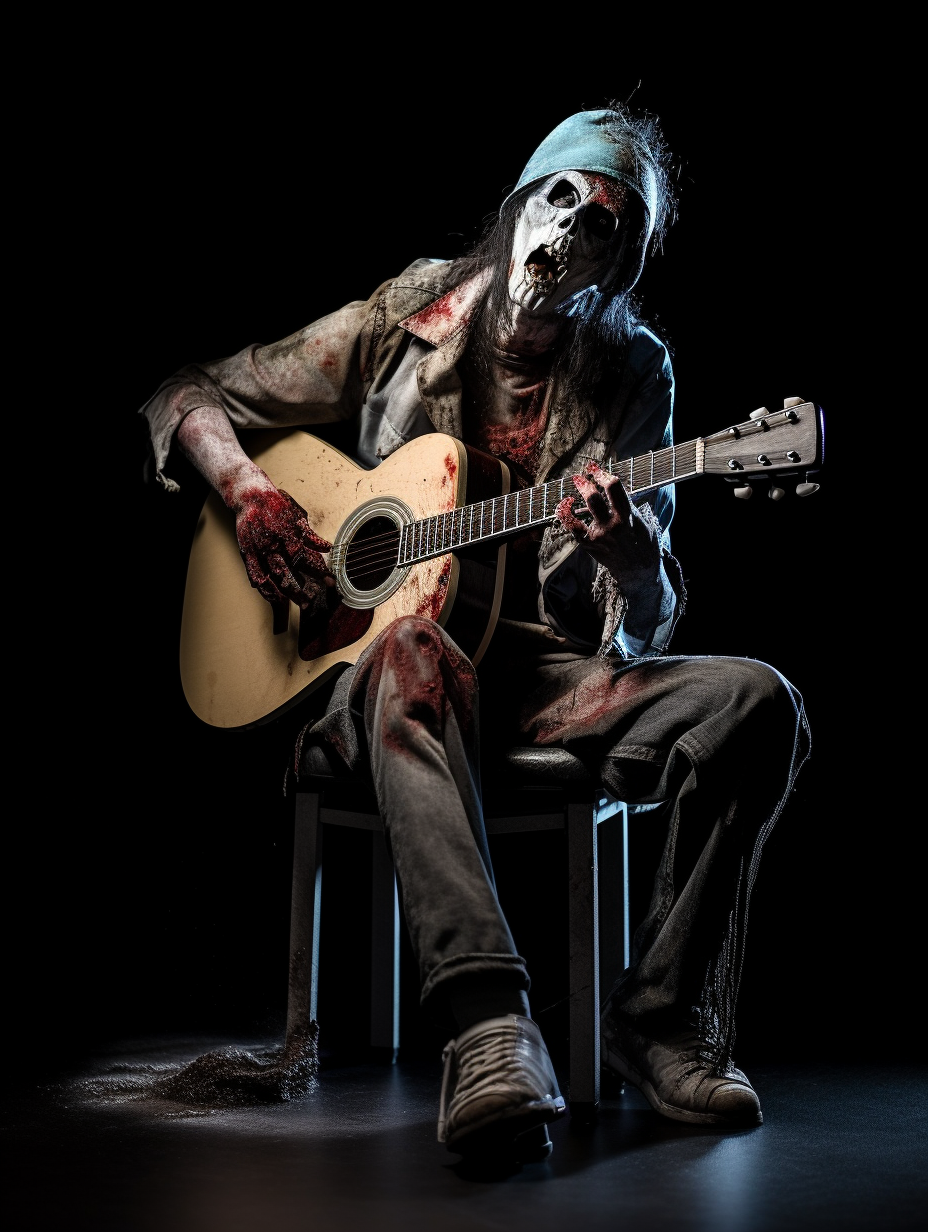
He sat on a wooden stool in the middle of the stage with an acoustic guitar balanced on his knee. He wore a faded blue knit cap pulled low over a face that wasn’t a face anymore. The skin had rotted away to bone in patches. The nose was gone. The jaw hung loose on one side, so his teeth clicked together when he sang. His jacket was gray with age and stiff with old brown stains. His jeans were black at the knees and rotted to threads at the hems. His sneakers were worn through at the toes.
His hands were the worst. The fingers were mostly bone, with strips of dried flesh hanging from the joints like wet paper. Every time they pressed the strings, a little more of them came away. Bits of him fell onto the guitar, onto the stage, onto the floor. Under the stool, a small gray hill of dust had grown, night after night, as if someone were slowly burying him alive.
He didn’t scare me at first. That’s the part I’m ashamed of. For the first week I thought I’d lost my mind. For the second week I sat in the back booth with a flashlight and listened, because the song was beautiful.
I tried to record him once. My phone caught the stage, the stool, the spotlight, and nothing else. No music. When I played it back, the only sound was a slow heartbeat, thump, thump, thump, and the soft whisper of ash falling. The next morning I asked Rosa, the day bartender, if she’d ever heard a guitar in the building at night. She laughed and said the only ghost in The Blue Hollow was my tip jar.
The song never ended. That was the thing. Every night he played the same slow, sad melody in a minor key, and every night he stopped one note short. His fingers would hover over the strings. His skull would lift, jaw trembling, like a man reaching for a word on the tip of his tongue. Then his hand would drop, a handful of ash would sift from his sleeve, and the spotlight would die.
One note short. Every single night.
I knew the song.
It took me nineteen days to admit it. I was wiping down the bar one afternoon, humming to myself, when I caught the tune in my own mouth and froze with the rag in my hand. I knew those chords. I knew that stumbling little bridge. My brother Danny wrote it in our mother’s kitchen when he was seventeen, strumming a secondhand guitar with a missing string. He called it “Cinderblock Lullaby,” because that’s what our house was built from, and because he said it was the only kind of lullaby we’d ever been given.
He wrote it for me.
Danny died eleven years ago, in a fire, in this building.
The Blue Hollow burned on a Saturday night in October. Danny was twenty-two, playing his first real gig on that stage, in a blue knit cap I had bought him for his birthday. I was supposed to stay. I was supposed to drive him home. Instead, I got into a stupid fight with him in the green room, over money, over nothing. I lit a cigarette, set it on the edge of an amp, and stormed out to the parking lot. I stood there for ten minutes, too angry to go back in. Then I got in my car and drove away.
By morning, there was nothing left but a black frame and a stage with a body on it.
The fire marshal ruled it electrical. I never told anyone about the cigarette. I told myself I’d tossed it in the lot. I told myself so many times that I almost believed it.
When the owner rebuilt, I took a job at the new bar. I told people it was to honor his memory. The truth is I couldn’t stay away. I had to keep watch over the place where I had failed him.
Now he was back, sitting under a spotlight, playing the song he’d written for me, one note short of the end.
That night I walked up to the edge of the stage. My heart slammed against my ribs. I stood at the border of the light and said, “Danny?”
He stopped playing.
The skull turned toward me slowly, like something heavy on rusted hinges. Two black sockets looked down from under the brim of the cap. Dust sifted from his cheekbone. His jaw worked, clicking, and a voice came out, a wet wheeze like air leaking from a punctured lung.
“Almost,” it said.
Then the light went out.
I lay awake all night, staring at the ceiling. In the morning I pried up the floor panel beside the stage, where the old boards had been burned black and covered over. The fire had left a few things behind. A melted lighter. A guitar pick. A scrap of blue wool, still stitched.
After that, I stopped sleeping. Each night the song crept a little closer to its ending. Each night his fingers shed a little more, and the ash under the stool rose higher until it had the shape of a man curled on his side. Each night he stopped one note short, and each night, in that wet wheeze, he told me the same thing.
“Almost.”
I begged. I cried. I told him I was sorry, that I’d give anything. He never answered. He just played.
Then the owner told us the bar had been sold to developers, and the wrecking crew would come on the first of December.
That was last night.
I closed at one. I sat in the back booth and watched the light click on. Danny played, and this time the song went on longer than it ever had, the chords climbing and bending toward the place where the melody always broke. I held my breath. He reached the last bar, the last measure, the last note…
And his fingers stopped on the strings.
I heard the doors lock.
All of them, one after another, like dominoes falling. The deadbolts slid home. The windows sealed shut. The smell of smoke drifted out of the walls, faint at first, then thick, with the taste of burnt hair and gasoline.
Danny lifted his skull. For the first time, he looked at me and kept looking.
“You left early,” he said.
I couldn’t speak.
“I was still playing,” said my brother. “I smelled it. I knew whose cigarette it was, Eli. The one you left on the amp.” His jaw clicked. “I’m not angry. I never was. I only wanted you to hear the end.”
The stage was burning. I don’t know when it started. Flames came up through the floorboards in sheets of orange and white, licking at the stool, the ash pile, the hem of his rotted jeans. They didn’t touch the guitar. They didn’t touch the cap. They crawled toward the booths, toward the bar, toward me.
“Danny, please…”
He bent his head over the strings, ruined fingers trembling, and he played the last note.
It was the most beautiful sound I’ve ever heard.
It filled the room. It filled my chest. For one moment the fire went soft and golden, and I saw my brother as he’d been, twenty-two and grinning under a blue cap, forgiven and forgiving. Then the heat reached my face and my hair and the booth where I sat, and I understood that forgiveness and justice are two different things, and the dead can have both.
The last thing I hear is the guitar. Danny is playing it from the beginning again, and this time he’s smiling with half a face, because he finally got the note right.
He’ll keep playing until I stop.
The Roots Beneath Black Hollow